Half Human, Half Newman
2015
Polyester, wood, sound recording
400 x 200 x 200 cm
Photo: Milan Krkač
This Confidence Man is a savior who only seems dark because he must work in a fallen world… if he might be the Devil or… Christ… his ‘true self’ is hopelessly hidden.
In these words, Lewis Hyde defines the co-called trickster, described in myths as the one who made the world as it is. Other deities intended to create an ideal world, but this one – in its complexity and ambiguity, beauty and dirt – is the work of the trickster, and it is not yet completed.
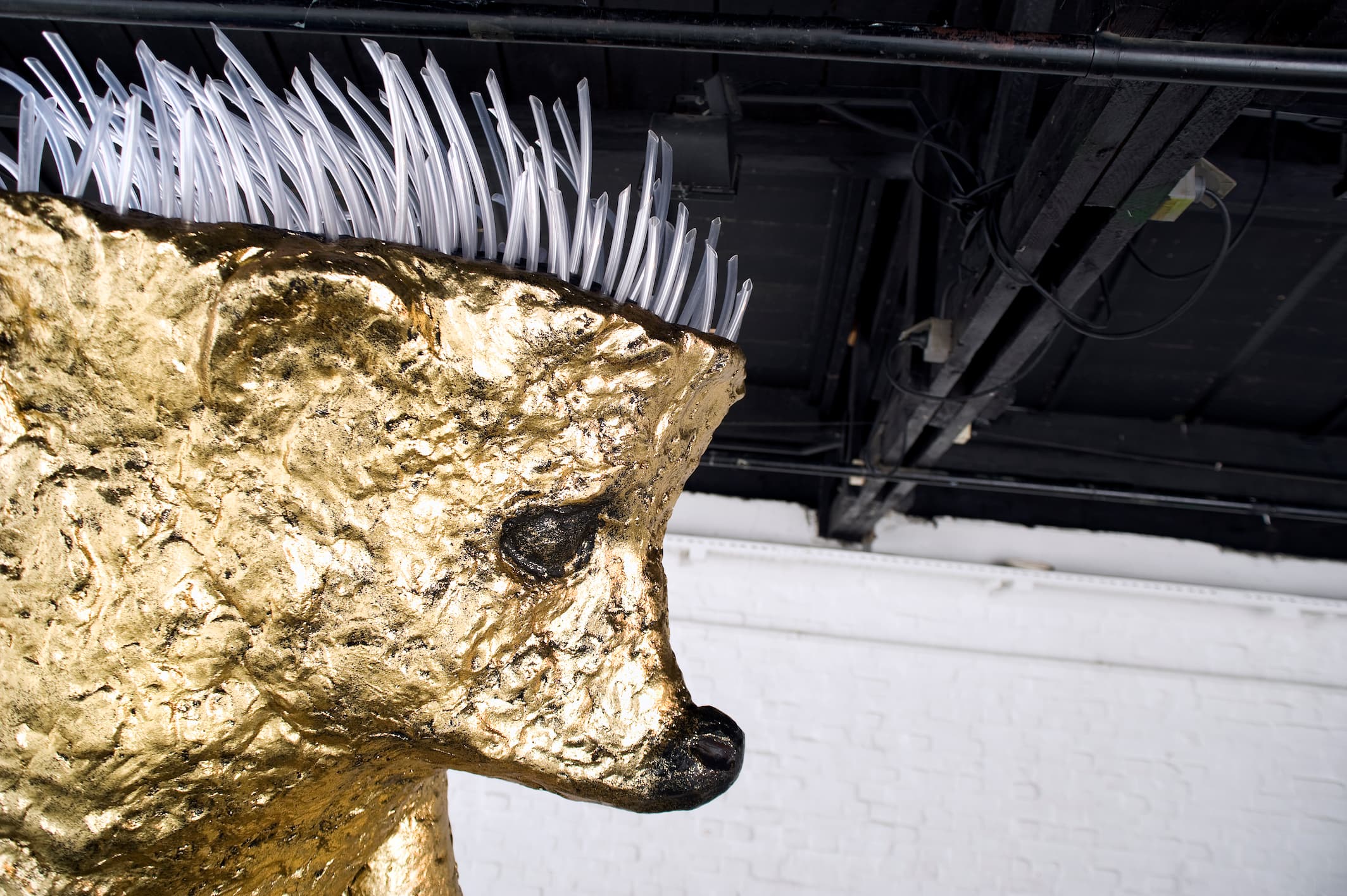
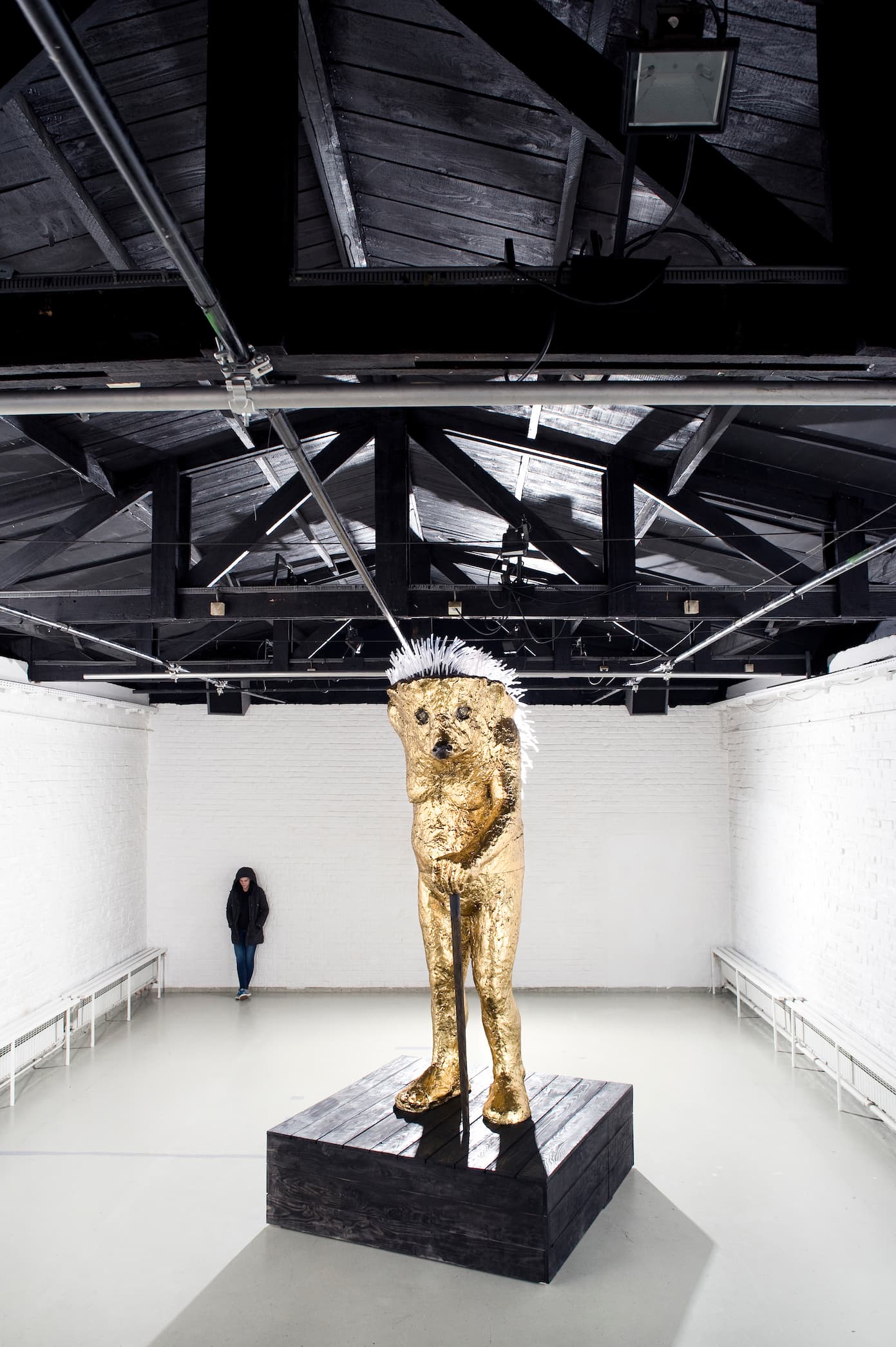
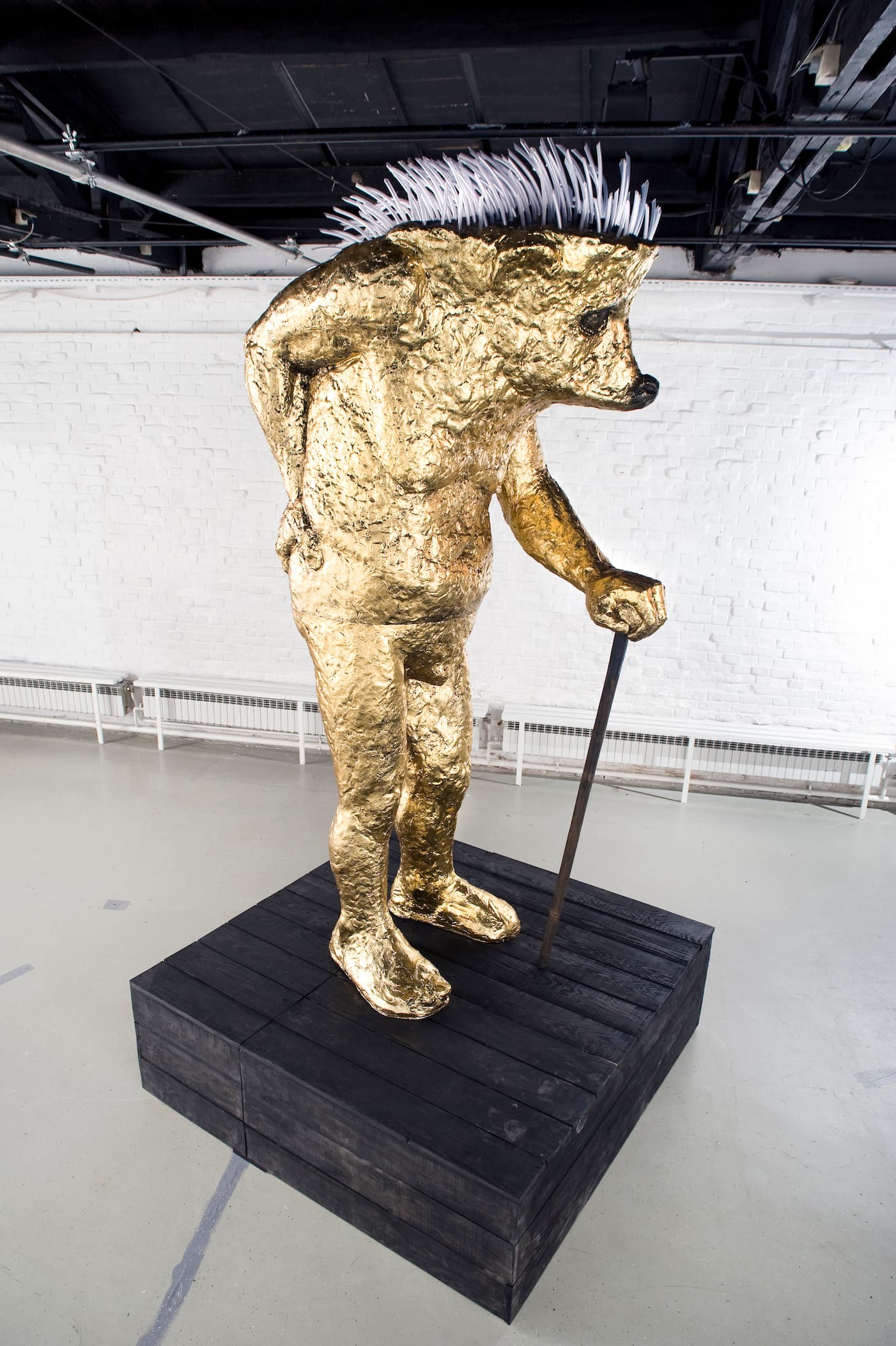
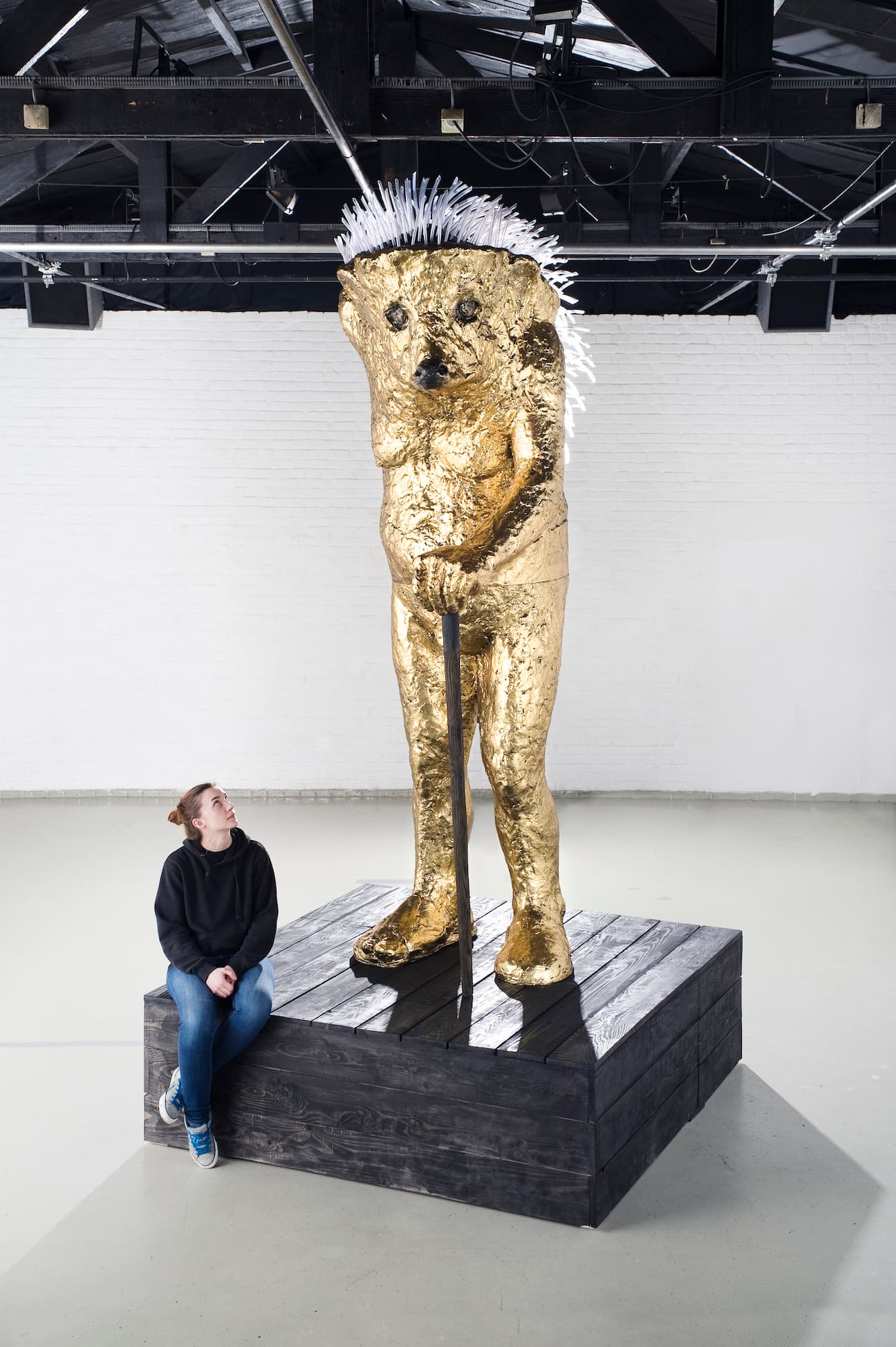
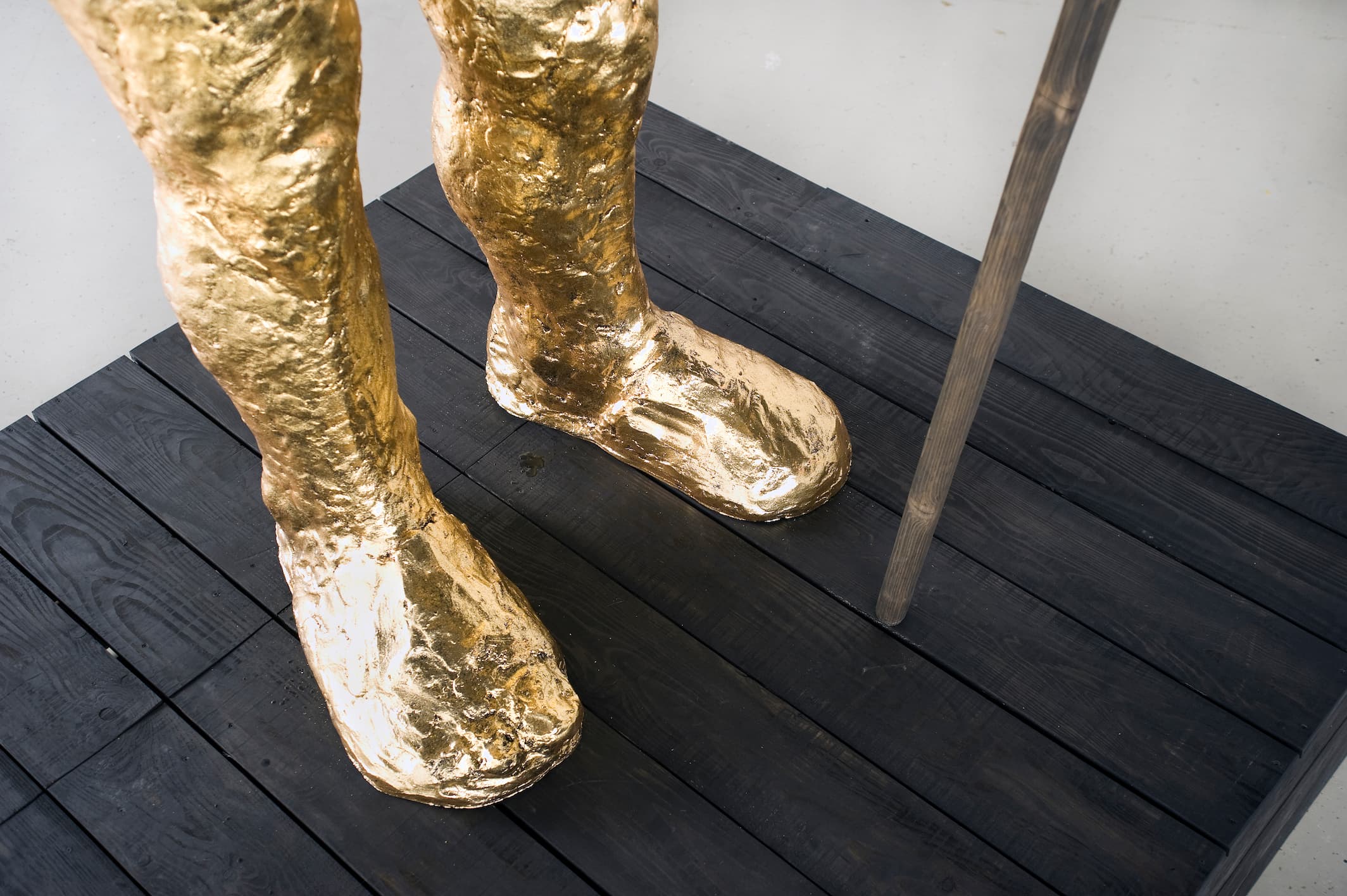
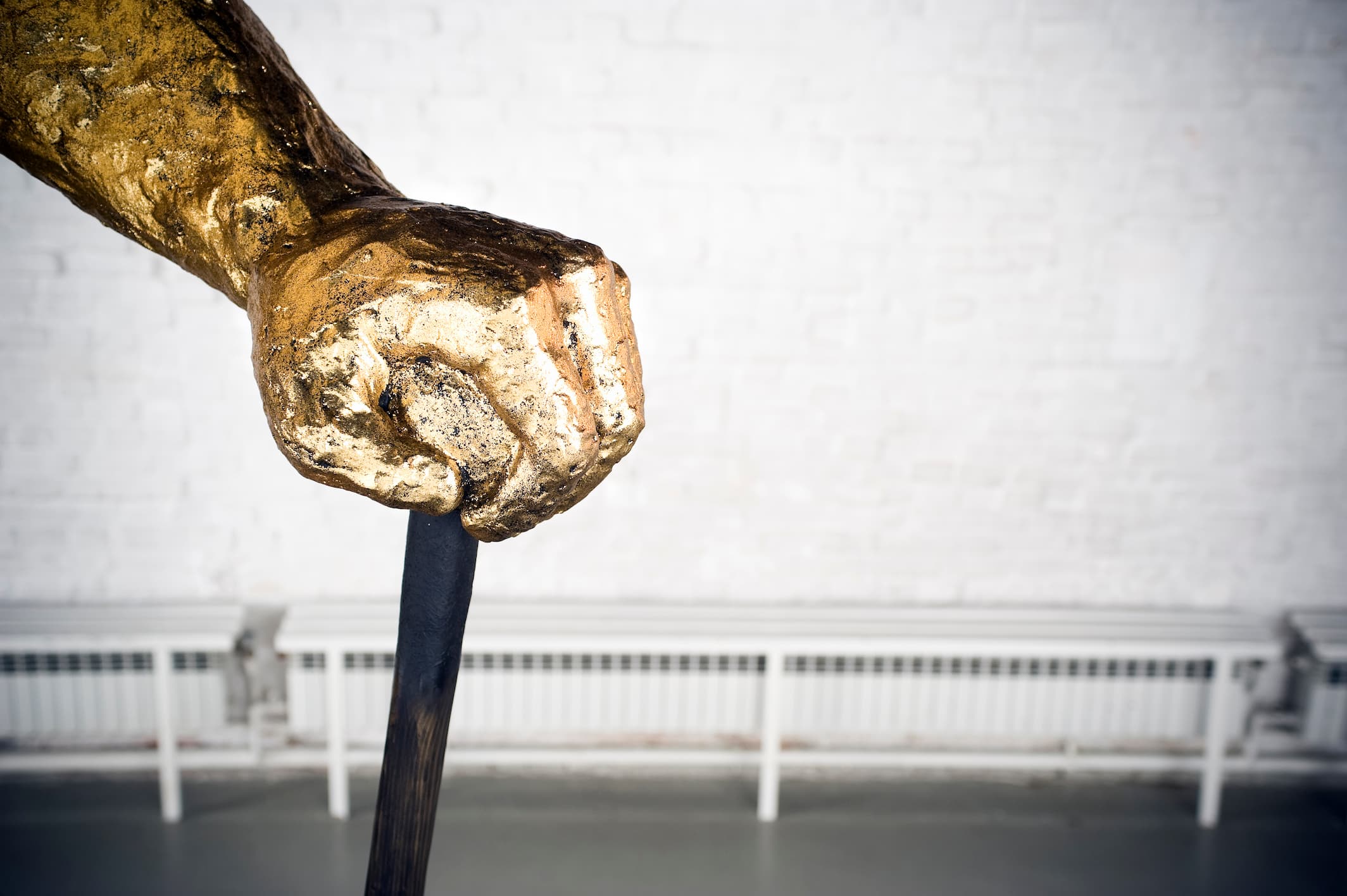
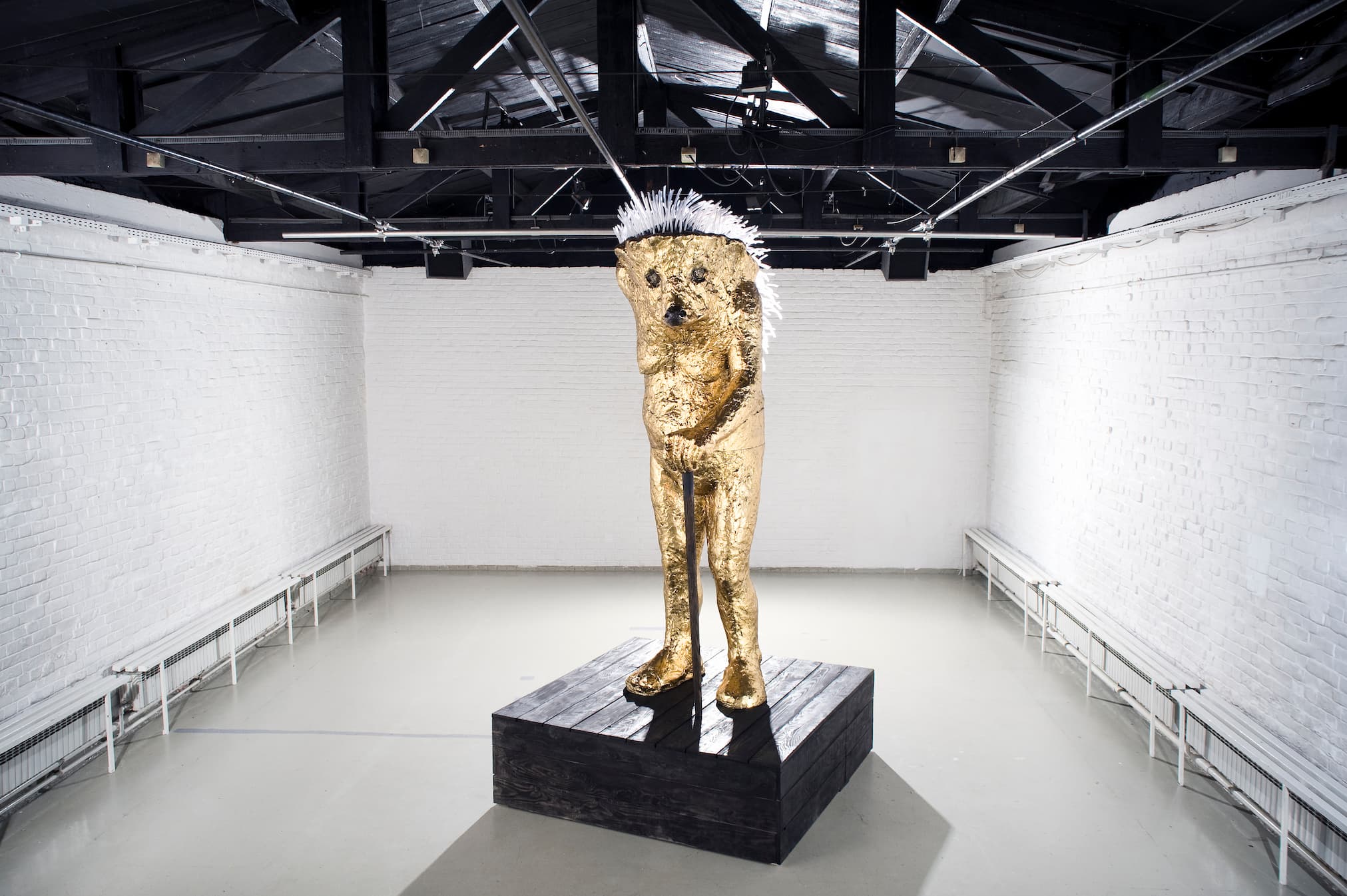
In her sculptural-exploratory work, Vlatka Škoro, a student of postgraduate study of sculpture at the Academy of Fine Arts in Zagreb, combines her personal imaginary of hybrid creatures with new technological possibilities, thus shifting the limits of the medium itself. This anthropomorphic oversized being inhabits our space as a messenger from another dimension. Carrying both human and animal characteristics, it does not belong to either of the realms, but pulls us into its own mythical one. The hedgehog is an animal filles with symbolism, from a greedy inhabitant of a medieval imaginary to a wise and good hearted forest guardian, it seems to be capable of taking on numerous meanings and interpretations. In folklore and folk tales, it often receives a highlighted position, it appears as the forest ghost daidarabotchi in Japanese mythology, while in the Slavic legend of the wedlock of the Sun and Moon, the hedgehog rescues humanity from all-devouring fire of the Sun. The author almost intuitively covers up this hedgehog-like creature in a dazzling golden surface which flutters on a matte black deep polyester. When approaching the dark exhibition area, we are welcomed by a hoarse echoing, an earthy sound which expands and draws us into a mistic atmosphere. Waves of rhythmic pounding on the floor, created by the staff, take us in and lead us into a half-trance state where time stands still, while the air dances. With almost inadvertent theatrical arrangements, the author captures our senses in an uninterrupted hypnotic dervish dance. The enormous shaman flickers in dimmed smoke and tries to shake us from within the stagnant lull of our reality – Beuys’s coyote taking on a different form. The hybrid doesn’t appear harmless and we perceive it as a part of our surroundings, as someone entering our space, and not as an oversized toy in the manner of Florentijn Hofman. The exhibit possesses a strong sculptural element – it is a real monumental sculpture whose lively modeling and visible hand emphasize the softness and strength of this enormous and somewhat awkward body towering over us.
An electromotor is placed in the moving hand and, alongside a powerful rolling bass with emphasized acoustic effects, creates an exceptionally suggestive atmosphere. It is precisely in the bond between technology and mythology that the true value of this sculpture lies. This creature is not merely a human-animal hybrid, but also a tie between the spirituality of the forest and the and the bionic world of technology. The sculpture is not necessarily connected to a singular subject matter, it is dependent on its placement, where it produces new meanings and generates social interaction – the spectator goes around it, takes shelter watches from the sidelines. Darkness, the dazzle of the golden-black surface, gigantic proportions, smoke and sound effects all purposefully invoke the spectator’s bewilderment and, for a moment, take him away to an interspace where he can detach himself from his surroundings and engage in a very personal interaction with the exhibit. In a way, this character displaces us by its presence – it is impossible to ignore, and not only due to its size. The authority of the forest wisdom, an animal that is both a child and an elder, is softened by the authors witty approach to the project, visible from the title of the exhibition itself, in which she manages to produce a pop effect with a deeper background. According to the author, this work is not a critique; however, in a very serious manner, it discusses the world and man, their symbiosis and their joint movement. The hybrid warns, cautions and awakens, but maintains a smile and mocking nature. What does it really imply?
Will we also hear ‘Dinsdale!’ and, prior to panically starting to look for Spiny Norman, all disoriented fall down a metaphoric rabbit hole?
Ana Bedenko